
On the last Friday of March, Adam Abdur‑Rahman found himself standing inches away from a giraffe. The very one Theodore Roosevelt collected over a century ago.
It was not a museum exhibit, and it was not open to the public. It was part of an exclusive SEEDS field trip to the Smithsonian Museum Support Center, one of many opportunities the Environmental Club now offers its members.
At Stevenson, of course, the Environmental Club plants trees and cleans streams. But they do so much more.
Fourth-year environmental major Abdur‑Rahman has worked with the club’s executive board to make this club a gateway to national research programs, funded field trips, and professional networks that students never knew existed.
“Coming to Stevenson, I had no prior knowledge of environmental science and was actually interested in engineering,” Abdur‑Rahman said. “Then, I asked Dr. Norris for some environmental opportunities, and he happened to be a member of the Ecological Society of America.”
The SEEDS Program, run by the Ecological Society of America (ESA), stands for Strategies for Ecology Education, Diversity and Sustainability programs.
SEEDS offers students funded opportunities to explore ecology through field trips, research experiences, and national networking.

When Abdur‑Rahman realized that Stevenson did not yet have a chapter, he worked with the Environmental Club to establish one.
By Spring 2024, the SU Environmental Club officially became a part of the SEEDS chapter, giving students access to a national community of researchers and institutions.
One of the chapter’s most impactful events came in fall 2024, when the club hosted a virtual information panel featuring Harvard researcher Audrey Barker‑Plotkin. Students and members from NYU, Cornell, and universities across California joined the session, which introduced research opportunities available to undergraduate students.
“There was a student who attended this panel who didn’t know anything about research opportunities before the event,” Abdur‑Rahman said. “They applied for an opportunity in Virginia that was mentioned during the panel, and they got the research opportunity,”
Moments like that, he explained, are what makes the club worth leading.
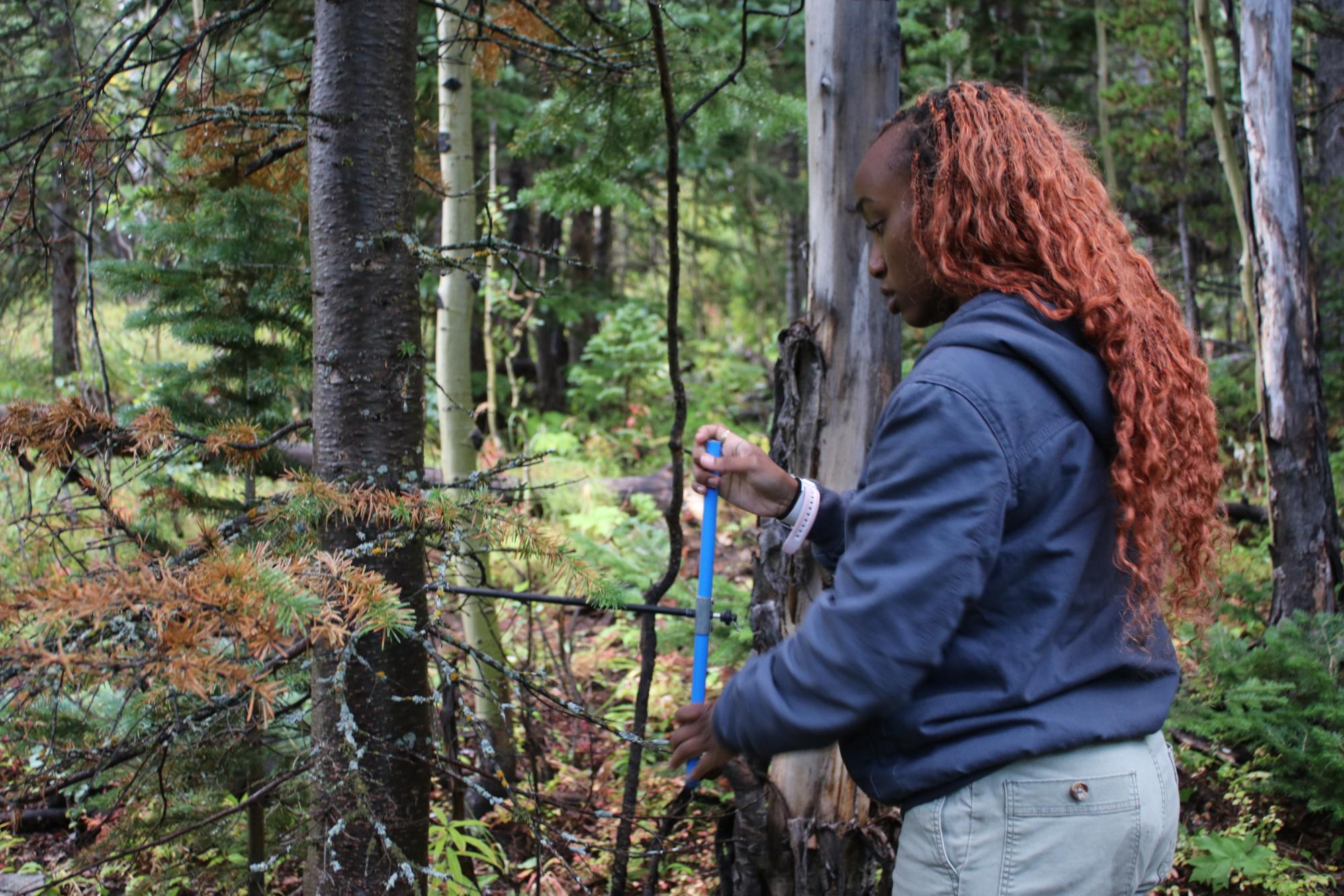
Third-year environmental science major Shawn Bessick joined the Environmental Club in her first year of college, hoping to relate to people with the same passion as her. She later joined SEEDS after attending the program’s national field trip to Colorado.
“Being a part of this club and chapter of SEEDS has shown me that everyone’s path isn’t linear and that everyone has to step outside of their comfort zone,” Bessick said. “The ENV Club makes you feel like you belong.”
Her favorite memory remains the Colorado trip, where she was the only student from Maryland selected to attend. The event was fully funded by SEEDS. She said the experience exposed her to new career paths and helped her understand that ecology is a field with room for many majors, not just biology or environmental science.
Professor of Biological Sciences at Stevenson and the club’s advisor for seven years, Mark Norris, said that he has watched the club evolve significantly since affiliating with SEEDS.
“There are increased opportunities for students…national and regional field trips, networking events, and they’re fully funded,” Norris said.
Norris recalled moments when the club exceeded expectations, including when national SEEDS leaders were brought to campus by Abdur‑Rahman and when alumni returned to speak about their career paths.
“Students need a mechanism for resources and advocacy,” Norris said. “And the club being affiliated with a national program like SEEDS provides exactly that.”
Looking ahead, the SEEDS chapter hopes to expand its outreach and increase diversity within the field. Bessick emphasized that environmental science can feel discouraging for students of color, especially women, and she wants the chapter to help change that.
“These people want you to be successful and experience these things,” Bessick said.
The Environmental Club is now preparing for Earth Week (April 20-24), one of its biggest campus events. This year, the SEEDS chapter will participate in the ESA’s National Bioblitz, a month‑long competition where students identify as many species as possible within a 24‑hour period.
According to the ESA, the Bioblitz brings together student chapters and the public to document biodiversity using the iNaturalist app.
On the final day of Earth Week, April 24, Stevenson students will take photographs of plants, animals, and other organisms during a stream cleanup. The chapter with the most observations wins a $250 prize, and the club’s Executive Board has added an extra incentive: the top Stevenson participant will receive a custom Environmental Club shirt designed by members.
For Abdur‑Rahman, the chapter’s mission is simple.
“Bringing national opportunities to the Stevenson community,” Abdur-Rahman said.
One that he hopes more students will take advantage of as the chapter continues to grow.